A decorative Flock Safety camera appears in the top-right of the banner, as if watching Crossville landmarks below.
Crossville · Cumberland County · Tennessee
CrossvillePrivacy
Flock Safety cameras already scan ordinary Crossville drivers, with no warrant and no suspicion. Taxpayers fund it. Tennessee already has documented police misuse of the same kind of system. County drivers can get scanned on some routes into town too—not every way in or out is covered yet—so use the Cumberland page for County Commission. Use the short summary below, then email City Council, show up with a 3-minute speech, and ask every Nov. 3 candidate to put a Flock yes or no on the record.
Independent Crossville resident research: not the City of Crossville, Crossville PD, or Flock Safety.
Sources include the city quote PDF and East Tennessee news reporting.
Corrections: info@crossvilleprivacy.org.
Local Crossville transparency check: (national dossier tallies as of ).
Got here from a card, a shared link, or a search? You’re in the right place. This page is Crossville’s research and action guide.
Short summary: what Crossville drivers should know
Your plate is scanned automatically, mass capture usually needs no warrant and no suspicion, unless the city writes stricter rules. See also Fourth Amendment.
Flock Condor cameras (people-tracking video) were documented livestreaming with no login in Dec. 2025 (~60-67 feeds), found via commercial search tools, not a “hack.” Crossville has not published whether any Condors are local. Open-streams dossier →
Canceling Flock does not fix the problem if the city just hires Axon (or another company) to keep scanning plates. Remove the cameras. Require warrants for specific lookups. Switching companies is not the answer.
One Tennessee story
A former Oak Ridge officer ran 18 personal Flock searches, pleaded guilty to 23 official-misconduct counts, and was sentenced in 2026. Flock’s product supports multi-agency search; Crossville has not published who can query local plate reads. Read the full misuse cases →
What to ask City Council
Ask for this firstCancel the Flock contract and remove the cameras.
Do not replace them with Axon or any other plate-reader company. Fix this by removing the cameras and requiring warrants for specific lookups, not by scanning every driver. Hiring a different company is not a win.
If they will not cancel yetYearly public yes-or-no renewal voteNo automatic renewal that skips a public vote, plus monthly use reports, a written search policy, and a public camera map.
Quote Q-00234: 10 Falcons · ~$25,000/yr. No city-published search policy found.Crossville PD runs Flock ALPRs. Quote Q-00234 proposed a recurring Falcon subscription (non-binding proposal, not an invoice) for 10 Falcons. As of a July 21, 2026 local check, this site has not found a city-published written search policy, official public camera map, or monthly detailed use reports (queries, hits, and who searched).
These counts come from this site’s nationwide case databases, not Crossville’s local camera program. They show the pattern other cities already documented: officer job losses, personal lookups, lawsuits, settlements, and municipal exits.
As of . The 94 misuse rows are catalogued incidents (73 verified, 21 aggregator-aligned). Fired / resigned (89), charged or arrested (59), and convicted or sentenced (8) count people in those rows, not rows (Savannah’s six terminations are six people). The three people-counts overlap: one person can be fired and charged, or charged and later convicted. A charge, arrest, or accusation is not a finding of guilt. Convicted counts a published guilty plea, no-contest plea, jury conviction, or sentence. The lookup total is a minimum known figure from only the 23 cases that publish personal-search counts (most do not). 25 wrongful-stop suits are separate from 5 constitutional / program challenges (Norfolk, Wichita, Boulder, Huntington, San Jose). Settlements sum to $3.68M across 12 paid wrongful-stop cases and include major non-Flock ALPR settlements cited for liability scale. 155 clear municipal exits; full cancel dossier has 207 records.
Full methodology on the National page
· Search misuse records
· Search wrongful stops
· Search exits
· National cases.
Act now
What to do in Crossville
Ask sitting council: cancel the Flock contract and remove the cameras. If they will not cancel yet, ask for a yearly public yes-or-no vote before any renewal (no automatic renewal that skips a public vote), plus monthly use reports, a written search policy, and a public camera map.
As far as this site can tell, Cumberland County does not run its own Flock or ALPR cameras. Crossville’s city cameras can still scan county drivers on some routes into town. Use the Cumberland page to push County Commission to ban ALPRs and similar AI tools, and to ask the Sheriff about network access to city Flock reads.
Before you vote: get a Flock yes or no you can quote. 3B Media posted the Election Commission qualifying list on Aug. 20. Regular seats: Mike Turner (incumbent), Kristopher Cole, Robbie Poore, Greg Wood, and Danny R. Wyatt. Unexpired Mayberry term: Cole, Melinda Kelsey, and Louis Morrison. That article does not quote a Flock or license-plate-reader position. Early voting starts Oct. 14.
Copy-paste question:
Will you vote to cancel Crossville’s Flock contract, remove the cameras, and refuse any plate-reader replacement (Flock, Axon, or otherwise)? If you will not cancel, will you require a recorded public yes-or-no vote each year before any renewal, plus a public camera map and monthly search reports (who searched, what, why, hits, and sharing)? Please put that answer on the record.
After an hours-long grilling of Flock and the Knox County Sheriff’s Office over purchases just under the $25,000 review threshold, commissioners passed an emergency ordinance banning fixed license plate readers. Coverage puts the removal deadline at September 16. Mayor Glenn Jacobs said he does not believe the county has a valid Flock contract; county staff will remove the hardware if the sheriff’s office does not. On September 10, Knox News reported Mayor Betsy Henderson said Flock will not remove the cameras until Oct. 7 and that the county will cover mounted units with “personal privacy shields” until takedown.
WIRED reconstructed Flock's OS Investigate interface from code on police login portals — the article includes a working simulation of what officers see. The AI tool can identify people and track movement patterns, despite Flock telling the public for years that its technology "cannot recognize, identify, or track individuals."
Mayflower, AR: ends Flock use immediatelyInterim chief called devices intrusive; contract through 2027 still unwinding. CAN-2026-072. Part of Arkansas wave with Cabot / Pea Ridge.
Flock Safety cameras & ALPR surveillance in Crossville, Tennessee
Public records and local reporting on Crossville’s Flock Safety automated license plate readers: how the city got the cameras (Chronicle), who oversees them, what they cost, and Tennessee misconduct cases that show what can happen when ALPR access lacks meaningful supervision.
How Crossville got Flock (2022)
In June 2022, Crossville Police Chief Jessie Brooks told council and local media the department wanted Flock cameras as “extra eyes” for investigations, Amber/Silver alerts, and locating vehicles already in law-enforcement databases, not as red-light ticket cameras.
On December 13, 2022, City Council minutes record that Chief Brooks “suggests purchasing License Plate Readers” as an eligible expense on a state Violent Crime Intervention Fund grant application ($126,378). The same consent agenda records Police Chief Brooks recommending a Flock quote of $28,500 to purchase 10 cameras with installation. The minutes say a budget amendment was not necessary because the item was approved in the FY 2022–23 budget, and that it was not bid because the city treated Flock as a sole-source provider. Council approved consent items 5A–T except M on a recorded 4–0 vote (Shanks, Gernt, Crawford, Turner).
Quote Q-00234 lists 10 Falcon ALPRs. City records produced under the Tennessee Public Records Act match that count: a 2023 Flock site list of 10 cameras, plus a 2024 list that relocates three of them. That is still not a city-published official map. See the site list. Confirm live invoices and any expansions through TPRA.
Crowdsourced ALPR locations around Crossville from the independent DeFlock project (OpenStreetMap). Pan and zoom to see reported cameras. The city still has not posted an official public camera map. Below the map is the 10-site list from city records. Ask council to publish a current map using our questions for City Council, or request the live inventory with a TPRA request.
The City of Crossville produced these locations under the Tennessee Public Records Act. They come from Flock’s 2023 installation list (10 sites, all on 12-foot Flock poles) and a 2024 relocation list for cameras #02, #05, and #07. This is a vendor plan the City held, not a stamped as-built survey, and not a map the City posted for the public.
No official city permitIn a June 22, 2023 email the City produced under the Tennessee Public Records Act, Engineering Director Tim Begley wrote that he had “discussed the locations with the City Manager and the City isn’t going to issue an official permit.” The same email said staff wanted to meet at each proposed location to fine-tune the spot, including moving a City Hall-property camera toward the southern edge of that property.
Flock camera sites from Crossville city records produced under the Tennessee Public Records Act
This is Flock’s plan as the City produced it, not a city-stamped as-built map. Compare it with the DeFlock pins above; volunteer maps can lag or miss a move. Anyone can request the same records from the City Clerk.
SourcesCity of Crossville TPRA production (June 22, 2023 email from Engineering Director Tim Begley; 2023 Flock list titled “TN - Crossville PD”; 2024 relocation list titled “TN - Crossville PD - Relo Cameras #02, #05, #07”). City-held records. This page transcribes the list; request the originals from the City Clerk.crossvilletn.gov
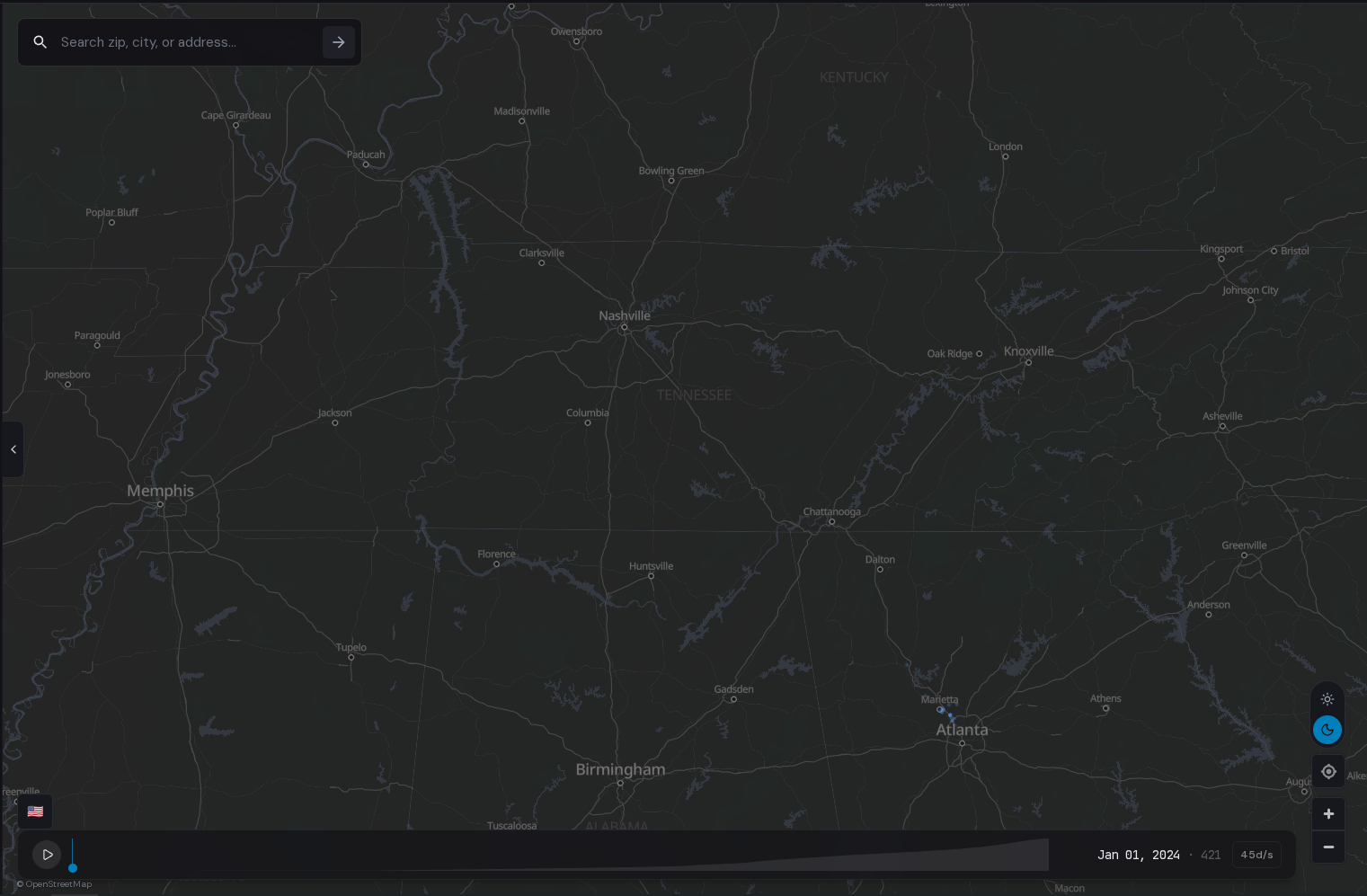
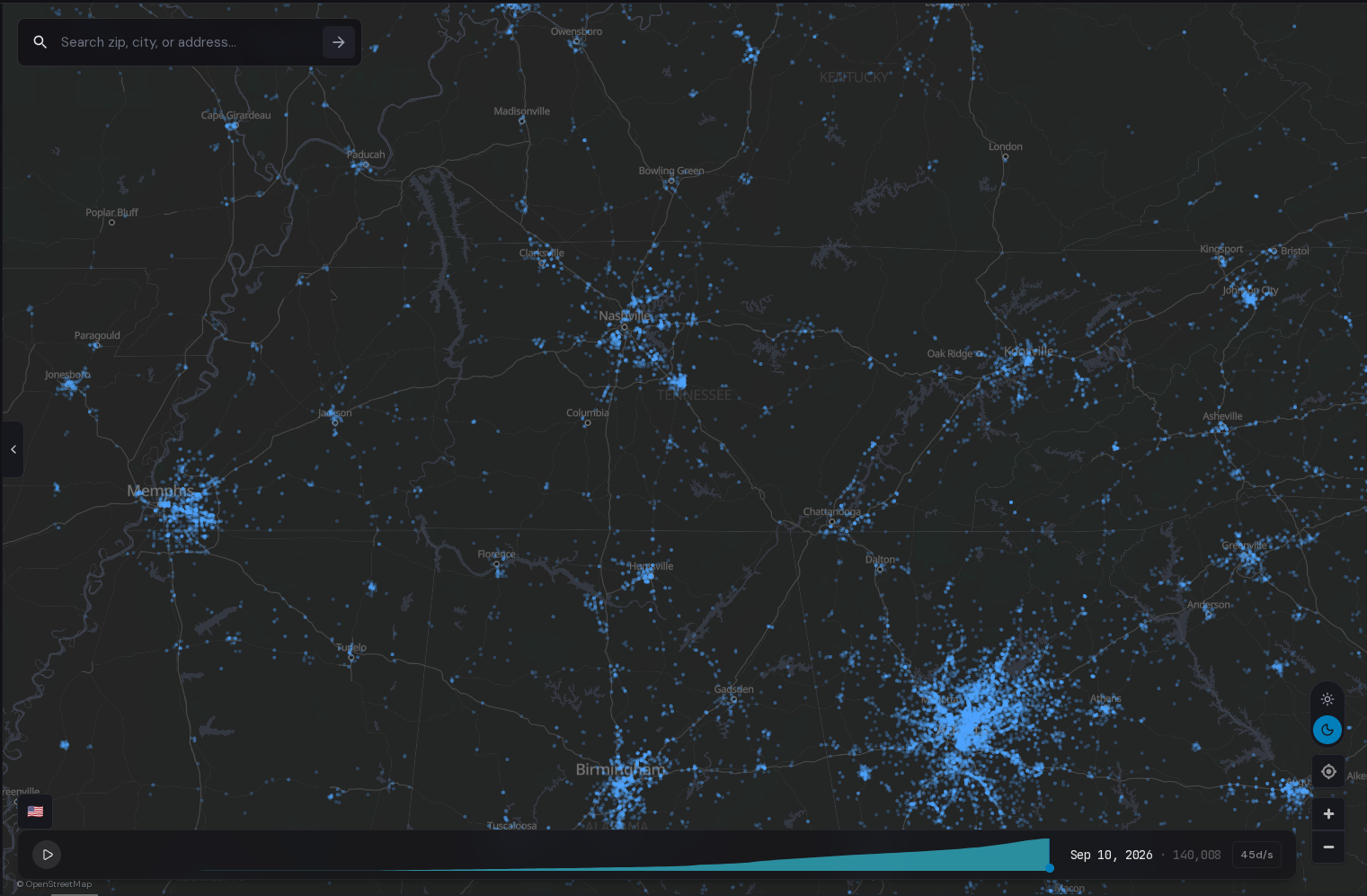
Mapped cameras, 2024 vs today
Community-mapped ALPRs on the independent DeFlock map. Left is Jan. 1, 2024. Right is Sept. 10, 2026. Dots are volunteer logs, not a city inventory.
United States · Jan. 1, 2024United States · Sept. 10, 2026
FreeForm AI search, Multi-Geo & Convoy travel tools, patent claims vs marketing, near-identical PIO language, the Aug. 2026 “Own the Narrative” council coaching guide, Condor (people-tracking video camera) livestream exposure, cybersecurity findings, and CEO statements, documented in the Flock dossier. The city is paying a subscription for vendor-owned cameras on a private cloud, not buying hardware it will own. Vendor cloud, not a city-owned camera →
Security failure worth reading firstIn December 2025, researchers found Flock Condor cameras (people-tracking video units) livestreaming on the open internet with no username and no password. Anyone who found the feed could watch live video, download days of archive, and reach admin panels through commercial search engines. Crossville has not published whether it runs Condor, Falcon, or both.
Read the open-streams dossier →Sources: open-streams dossier · 404 Media · Benn Jordan / Jason Koebler reporting linked there.
Cameras were pitched in 2022 and funded in the FY22-23 budget. Today’s council and staff control renewals, written policy, and whether residents get a real public process. Roster and speaking tools are on the City Council page; emails and the August letter are in Contact below.
These systems often launch without meaningful public oversight
Across agencies, ALPR portals (Flock today; Axon Fleet / Evidence tomorrow) commonly let an officer open a search window, type a free-text “reason,” and pull travel history immediately. Supervisor approval is optional unless a city writes it into policy. Audit logs exist on paper; few Tennessee cities publish them, see audit-log redactions and Tennessee misuse. Switching companies does not create real oversight, see Not just Flock.
Hard ban on personal / romantic / conflict searches, see misuse cases
Full contract, renewals, camera map, and sharing list: TPRA
Claims vs records
Flock / PD talking points vs. what Crossville records show
Vendor and local marketing tends to sound narrow (“extra eyes,” Amber alerts, database hits). Public documents from Crossville, and the East Tennessee network record, describe a broader, warrantless scanning platform.
Claim / framing
What public records & reporting show in Crossville
“Extra eyes” for investigations, Amber/Silver alerts, and vehicles already in LE databases, not red-light tickets
Chief Jessie Brooks’ 2022 pitch (Chronicle / 3B Media). That framing does not create a warrant requirement, does not stop mass capture of ordinary drivers, and does not itself publish search rules. Flock later dropped the public “not used to enforce traffic violations” line, and Georgia mailed a phone-use ticket citing a Flock image; Crossville has not published a written ban. See traffic-ticket mission creep. Flock also pays GlobeNewswire to push abduction/missing-child press releases onto aggregators; the Electronic Frontier Foundation and Techdirt (a tech news site) report Flock provided fill-in-the-blank PIO press-release templates; and Flock buys labeled sponsored articles in police trade media (IACP), see Flock’s PR playbook.
A limited 10-camera deployment
Quote Q-00234 lists 10 Falcons. City records produced under TPRA include Flock’s 10-site list and a 2024 relocation list for three cameras. The city still has not posted an official public map.
A manageable annual tool cost
$25,000 recurring on the 2022 quote (+ $3,500 implementation). Multi-year projection on this page shows six-figure cumulative spend if renewals continue at quoted rates, before any expansion beyond 10 cameras.
“Proper guardrails” / responsible sharing
Crossville still has not published a complete ALPR use policy, monthly audit totals, supervisor-approval rule, or public list of agencies that can query local plate reads. A redacted TPRA search log is now on the records page. Residents are still asked to trust a system without those city-published documents: request them via TPRA.
Cameras “don’t track people” / only plates
Flock markets FreeForm natural-language search for vehicles and people by clothing/appearance (e.g. “man in blue shirt and cowboy hat”), plus Vehicle Fingerprint attributes beyond plates. 3B Media quoted in the FreeForm section wrote that Crossville PD located a truck “by filtering for the truck’s specific features.” This site cannot confirm that search was FreeForm. The article does not name the product, and Crossville has not published which search tools are enabled. See also InvestigateTV on training materials vs. public framing.
Lookups are for known suspects / stolen cars only
Flock’s Multi-Geo and Convoy Search tools find vehicles that appear in multiple cities and vehicles that travel together, tracking travel history and associations without a warrant. East Tennessee training materials describe officers saying they had probable cause (“got PC”) from a Detroit-Knoxville travel pattern alone. Crossville has not published whether those tools are enabled or audited locally.
Company servers are locked down / feeds aren’t public
National Condor exposure (Dec. 2025): researchers found Condor people-tracking cameras livestreaming with no username and no password (~60-67 feeds). Verified on-site by 404 Media. Crossville has not published whether it runs Condor, Falcon, or both, so do not assume local exposure without that answer. See open livestream exposure.
Transparency portal = public accountability
The expected Crossville TN PD Flock portal URL was not publicly available as of July 2026, so there is no working public company page residents can check. Even a live portal would not be a city-published policy, camera map, or audit log. See the transparency portal section.
Misuse is rare / elsewhere
A former Oak Ridge officer pleaded guilty and was sentenced after 18 personal Flock searches (23 official-misconduct counts). Regional misuse is not theoretical for drivers whose plates enter a shared vendor network. See Tennessee misuse.
Public-records hit ratios are typically well under 1% of plate scans; a match to a wanted or stolen-vehicle list is not a cleared case. Independent and records-based analyses (the Electronic Frontier Foundation and MuckRock public-records work, Spokane Flock audits, Atlanta FBI solved-case data) undercut the marketing claim, see Does this solve crime?.
Does this solve crime? What public records actually show
Vendors and some departments pitch ALPRs as a major crime-solving tool. Public-records releases and independent analyses tell a different story: these systems photograph nearly everyone who drives past, then match only a tiny fraction to wanted or stolen-vehicle lists, and even those “hits” are not the same as cleared cases. Crossville has not published local Flock results (arrests, recoveries, or cases closed because of these cameras). Ask for them under TPRA and our questions for City Council.
Hit ≠ solved crime.A “hit” usually means a scanned plate matched a hotlist entry (stolen, wanted, etc.) at the moment of capture, not that police made an arrest, recovered a car, or cleared a case. Search volume and solved-case rates are separate questions. Vendor “crimes solved” claims are marketing until the city publishes attributable local numbers.
What the records show
Numbers (sourced)
Sources
California CPRA hit ratios, almost all scans are ordinary drivers
The Electronic Frontier Foundation’s Data Driven 2 table (agency-supplied detections vs. hotlist hits): Glendale PD 0.04%; Burbank PD 0.05%; Roseville PD 0.03%; San Joaquin County SO 0.04%; Modesto PD 0.06%. Earlier EFF California CPRA work found San Diego ~0.02% crime-connected at collection (98 of 493,000) and Irvine ~0.02% (40 of 217,000 over 90 days). Also, Business Insider reported Roseville police found Flock misread plates in 71% of stolen/felony alerts (a different metric from hit ratio).
What about Flock’s “10% of U.S. crime” / “20% of cleared cases” claims?
Those figures come from vendor marketing and Flock-funded / customer-survey studies, not Crossville outcome reports. Techdirt and 404 Media reporting documented Flock steering researchers, filtering inputs, and interfering with public-records access around those studies. Those are sales claims. Demand Crossville’s own monthly totals: searches, hits, arrests, recoveries, and sharing, not a national brochure.
Flock sometimes publishes agency “transparency” pages for partner departments. The expected Crossville TN PD portal URL is https://transparency.flocksafety.com/crossville-tn-pd. As of July 2026 that URL was not a working public transparency page (requests fail / the page is unavailable). Crossville either has not activated a public portal, or the URL/structure changed. Compare with what residents still need in our questions for City Council.
Vendor-reported network / sharing context for the partner agency
Marketing-facing “transparency” metrics Flock chooses to display
A hint that the agency sits inside a multi-agency product network, not a single stand-alone camera system
What Crossville still has not published
Written ALPR search policy (who, why, supervisor approval)
Monthly public audit summaries of plate searches
Official public camera map + renewal costs beyond the 2022 quote
City-authored list of agencies that can query Crossville plate reads
A working public Flock transparency portal page (unavailable as of July 2026)
What you can do: Check the portal URL from time to time. If it goes live, save screenshots of any sharing or network figures and send them to City Hall with a TPRA request for the underlying agreements. Until then, use the TPRA templates for policy, audits, contracts, and sharing lists. Elsewhere in East Tennessee, MaryvillePrivacy.org used portal data to show gaps between “no formal agreement” messaging and large external-agency visibility.
Flock changed which fields appear in cross-agency audit logs
In November 2025, Flock advertised “immutable accountability”: every user action and search reason kept in an indefinitely available audit trail. On December 11, 2025, Flock’s Network Audit Logs stopped showing officer names, specific plates searched, vehicle fingerprints, and open-text search reasons. That change followed public scrutiny of audit data (including tools such as Have I Been Flocked that used those fields). Flock said the change was intended to protect officer safety and investigations. Reporting found it was also applied retroactively, with portal fields replaced by “REDACTED”, see sources below and misuse cases that relied on searchable logs.
Vendor marketing is not a Crossville audit.If the city leans on Flock’s transparency claims instead of publishing its own monthly search summary and a supervisor-approval rule, residents lose the fields that helped uncover personal-use abuse elsewhere. Ask for city-held logs under TPRA, and ask which fields Flock still delivers to Crossville PD.
Footnote4a published the Dec. 9 customer email from Flock VP Chris Colwell spelling out the field removals.
Unfiltered Ledger and Atlanta News First documented the oversight impact: cross-agency logs became far harder for the public to use to spot stalking.
Flock has said omitted fields remain available to the originating agency, which only helps Crossville if the city actually pulls, reviews, and publishes audit summaries.
Projection from Flock Quote Q-00234 (10 Falcon cameras @ $2,500 each = $25,000 / year recurring, plus $3,500 one-time implementation). Confirm current invoices with finance / police budget files (TPRA).
Quoted baseline only; excludes tax, add-ons, and the 11th camera
10-year total
$253,500
$3,500 + ($25,000 × 10)
Per camera / year (quoted)
$2,500
Subscription line on Q-00234
Contract start date on quote: 08/26/2022. If Crossville renewed each year through 2026 at the quoted rate, cumulative spend would be roughly six figures (about $100k+ after several years, before tax or any 11th camera), while still lacking a published policy, map, and audit. Confirm actual invoices; the 2022 quote is not proof of every renewal. Open Quote Q-00234 → ·
Tax dollars fund the subscription. Ask for the invoice, the camera map, and a written search policy.
Municipalities that cancelled, removed, or let Flock expire
Cities across the country have terminated contracts, refused renewal, or let Flock expire, often after residents filled council meetings. Quitting Flock is not always quitting ALPR (some cities then hire Axon). Spotlights (Oshkosh, Verona, Staunton) and the full nationwide list live on the National cases page.
Canceling Flock is not enough if Axon (or Leonardo, Motorola, …) replaces it
Cities that drop Flock sometimes install Axon plate readers next, or shop other ALPR brands. Axon also runs Community Connect, a national private-camera registry (Knoxville is already listed). Read the Axon / Fusus / Leonardo / Vigilant writeup in the Flock dossier.
Crossville’s Flock quote figures and the verified research databases (National cases) point to a distinction city leaders often miss:
Tennessee Code Annotated § 55-10-302 is a storage cap, not a grant of immunity from federal civil-rights claims
if an ALPR-driven stop is later alleged to be unconstitutional. That is a civic reading of the statute’s scope, not legal advice, and not a prediction that Crossville will be sued or will lose. This site is independent research, not a law firm. The vendor markets the camera; settlements in other cities have been paid by taxpayers.
Roseville, CA: police found Flock incorrectly read plates in 71% of 1,427 stolen/felony vehicle alerts (2023–24). Roseville said incorrect alerts did not produce stops because officers must verify first.
Low match rate to wanted lists / mass innocent scanning, e.g. Glendale PD 0.04% and Burbank PD 0.05% hit ratios in the Electronic Frontier Foundation’s California CPRA table; CHP document ~0.3% alerts per reads (86,899 alerts / 27,545,659 reads). See also Does this solve crime?.
HaveIBeenFlocked.com is an independent tool that helps people understand how ALPR networks log plate sightings. It is useful context for Crossville drivers, not a substitute for city transparency.
Why it matters here
Crossville cameras feed a shared vendor network other Tennessee agencies can join.
A plate “hit” can just mean your car drove past a camera on a normal errand, not evidence of wrongdoing.
Misuse cases (Oak Ridge and national job-loss cases) show easy searching with no warrant required.
Primary Crossville documents and TPRA templates live on the records page. Bibliography: sources. Vendor background: Flock dossier.
Regional network
East Tennessee ALPR network: Crossville’s place in it
FOX 17 Middle Tennessee coverage, Knox County’s $800k / 10-year PO fight, the pause / Commission debate, and the East TN comparison table live on the Tennessee page.
Other residents and groups are documenting Flock contracts, mapping cameras, filing public-records requests, and publishing misuse cases. The full list is on Resources. Crossville-specific contacts and templates stay on this site.
TCA § 55-10-302 may limit retention windows, but it does not create a municipal immunity shield against 42 U.S.C. § 1983 claims. Crossville still chooses whether to keep buying the product.
Key precedents & what dense Flock networks look like in court
United States v. Jones (2012): Justice Sotomayor’s concurrence warned that GPS-style monitoring can assemble a precise record of a person’s public movements and is “susceptible to abuse.”
Carpenter v. United States (2018): historical cell-site location information generally requires a warrant; the Court recognized privacy in “the whole of [a person’s] physical movements.”
Commonwealth v. McCarthy (2020): the Massachusetts Supreme Judicial Court warned that with enough ALPR cameras in enough locations, historic plate-location data would invade a reasonable expectation of privacy.
City Attorney Randy York told Crossville City Council on August 12, 2026 that a Sixth Circuit decision and Tennessee’s plate-display rule mean motorists have no expectation of privacy in a license tag, and that Crossville’s cameras are plate readers only. That is the city’s legal position as reported. It is not a ruling about Crossville’s network. Carpenter, Jones, and McCarthy treat long-running, searchable location logs as a different problem from one officer reading a plate in traffic. Speakers at the September 1 work session made that warrantless-search argument again. Knox County’s August 31 ban is a local ordinance, not a court holding. The introduced Flock-Off Act would cut federal money for ALPRs; it would not, by its own terms, ban cameras a city pays for locally. This site is not legal advice.
Plain-language writeup of the “no expectation of privacy in public” argument, with the same cases: Why it matters. Secondary fact sheet collecting the same constitutional / Norfolk points for another city’s organizers:
DeFlock Birmingham: The Facts.
Civic action
What you can do: push back lawfully
Ask City Council to cancel the Flock contract and remove the cameras. If they will not cancel yet, ask for a yearly public yes-or-no vote before any renewal (no automatic renewal that skips a public vote), plus monthly use reports the public can check. The steps below are ordinary civic action (email, public comment, records requests, printables). This is not legal advice. Tennessee law on plate covers is linked at the bottom of this section.
Other questions worth asking: who can search, FreeForm/patent features, federal sharing, livestream exposure, and retention. Those are on the City Council question list.
What works best
Pack City Council meetings. Work sessions are 5 PM on the 1st Tuesday; council is 6 PM on the 2nd Tuesday at City Hall. Bring a 3-minute speech script and a neighbor.
Ask Nov. 3 candidates on the record whether they will cancel Flock and take the cameras down. Names and answers: Election 2026 scorecard.
Email leaders with the September agenda letter. Cancel first; yearly public vote if they stall.
Illegal in Tennessee:T.C.A. § 55-4-110
prohibits tinted or camera-blocking license plate covers, even if the plate remains “readable.” Do not obscure your plate. Statute: T.C.A. § 55-4-110.
Contact Crossville officials
Coming to council beats email alone, but do both. Start by asking them to cancel Flock and remove the cameras. If they stall, ask for a yearly public vote with no automatic renewal that skips a public vote. Ready-to-read scripts: 3-minute speeches.
Resident email template: September recorded vote
Copy this letter and send it from your personal email. Customize the second sentence if you have already spoken at a council meeting. Councilmember Fox has no published city email: City Hall (info@crossvilletn.gov) can forward, or use the council contact form.
Mayor Crawford, Mayor Pro-tem Gernt, Councilmembers Turner and Fox, City Manager Hale, and Chief Brooks:

I am a Crossville resident writing about the City's Flock Safety cameras.

I am writing to request that the following item be placed on the next work-session agenda for discussion and the next regular City Council agenda for a recorded yes-or-no vote:

Motion: Direct the City Manager and Police Department to give timely written notice of non-renewal, cancel Crossville's Flock Safety contract at the earliest lawful date, and remove all Flock cameras from City property.

The 2022 vendor quote listed a start date of August 26, 2022. This site has not seen a published live contract or notice-to-cancel deadline. Residents deserve a public, on-the-record decision before any renewal, not an automatic renewal that skips a public vote.

If Council will not cancel, I ask that you still take a recorded vote on whether to renew, with no automatic renewal that skips a public vote.

Please confirm in writing:
1. Whether this will be placed on the September agendas; and
2. The last date by which the City must give notice to prevent automatic renewal.

I will attend the next council meetings and ask for this vote during public comment.

Thank you for your time and for a clear written response.
Do Flock / ALPR cameras actually solve much crime?
Public-records hit ratios are typically well under 1% of plate scans, and a “hit” on a wanted or stolen-vehicle list is not a cleared case. Public-records work by the Electronic Frontier Foundation and MuckRock, Spokane Flock audit math, and Atlanta FBI solved-case comparisons all undercut the sales pitch. Crossville has not published local results. Full writeup: Does this solve crime?.
Do Crossville Flock cameras require a warrant?
No. License-plate cameras scan vehicles automatically. Searching stored travel history is usually a lookup in the police system with a typed reason, not a warrant, unless the city writes stricter rules.
How many cameras does Crossville have?
Quote Q-00234 lists 10 Falcon cameras. City records produced under the Tennessee Public Records Act include a 2023 Flock site list of those 10 cameras and a 2024 relocation list for three of them. The city has not published an official public camera map. Transcribed list: city records, 10 planned sites.
Where are the cameras on a map?
The city has not posted an official public camera map. City records produced under the Tennessee Public Records Act include Flock’s 2023 10-site list and a 2024 relocation list for cameras #02, #05, and #07; that list is transcribed at city records, 10 planned sites. The DeFlock map shows community-reported ALPR locations around Crossville via deflock.org. Coverage on DeFlock may be incomplete until more residents report cameras.
What does it cost?
Quote Q-00234 shows $25,000 recurring for 10 Falcons plus $3,500 implementation (total proposal $28,500 before tax). At those rates, a 5-year horizon is about $128,500 and 10 years about $253,500 see the cost projection. Confirm current renewal pricing with finance/police budget files.
How do I request Crossville’s Flock records?
Use the copy/paste TPRA templates and email info@crossvilletn.gov (ATTN: City Clerk), CC’ing the City Manager. Ask for contracts, policies, audits, sharing lists, and camera inventories.
Is it legal to cover my plate to beat ALPRs in Tennessee?
No. T.C.A. § 55-4-110 prohibits tinted/camera-blocking plate covers. Use council, email, and TPRA instead. Do not obscure your plate.
Has Flock ALPR been misused in Tennessee?
Yes for confirmed Flock misuse: a former Oak Ridge officer pleaded guilty and was sentenced after 18 personal Flock searches (among 23 official-misconduct counts), two years per count with 48 hours to serve, per local reporting. See the Tennessee misuse section.
Is canceling Flock enough if the city hires Axon instead?
No. Multiple cities have dropped Flock and then installed Axon plate readers to keep scanning cars: Denver, Douglas County (CO), Grand Chute (WI), Syracuse (NY), and others. That changes the company name. It does not end mass plate scanning. Other vendors shop the same job (Motorola Vigilant, Rekor, Genetec, Leonardo ELSAG / SignalTrace). Axon products raise separate concerns too (AI report-draft tools that delete drafts; an Atlanta ethics case involving an official who owned a stake in Fusus while pitching it). Do not demo, trial, or “evaluate” Axon or any other plate-reader brand. Ask council to cancel Flock, remove the cameras, and refuse any plate-reader replacement. Fix this by taking the cameras down and requiring warrants for specific lookups, not by scanning every driver. Full writeup: Not just Flock ·
Other vendors ·
Gadget Review (July 20, 2026).
Is Flock only license-plate cameras, or drones too?
Flock’s catalog already includes docked Drone as First Responder aircraft that launch to 911 calls, plate-reader hits, or gunshot alerts. On the Aug. 18, 2026 All-In podcast, CEO Garrett Langley told Business Insider drones are now the company’s fastest-growing line, with more than 200 DFR customers, while ALPRs are under half of forward-looking revenue. Crossville has published Falcon plate readers. It has not published whether any Flock drone product is in the live contract. Ask council before assuming the local deal is “just cameras.” Full writeup: CEO / All-In.
Can Flock cameras be used to issue traffic tickets?
The 2022 Crossville pitch said they were not red-light ticket cameras. Flock’s own materials used to say the cameras are not used to enforce moving violations. That language was removed after December 2, 2025. In Georgia, a mailed phone-use ticket cited a Flock image. Crossville has not published whether traffic-ticket use is enabled here, or a written ban. Full writeup: Traffic tickets.
Does Flock track people, or only license plates?
Flock’s core product is vehicle LPR, but FreeForm adds natural-language search that can include people descriptions (for example clothing). The company markets that cameras are not face identification. Also, Multi-Geo and Convoy Search track cross-city travel and vehicles that move together, tools that track daily travel patterns, not “only a plate hit.” Crossville should disclose whether FreeForm, Multi-Geo, and Convoy are enabled.
What are Multi-Geo and Convoy Search?
Multi-Geo finds vehicles that appear in two or more cities inside a time window. Convoy Search flags vehicles that repeatedly show up near each other. East Tennessee training materials describe officers claiming probable cause (“got PC”) from a Detroit-Knoxville travel pattern alone. Full writeup: Multi-Geo & Convoy.
Were Flock livestreams really left open on the internet?
Yes, reporting in late 2025 documented dozens of Condor-class feeds (Flock people-tracking video cameras) discoverable via commercial search engines with no login. See the open livestream exposure section and its sources.
What are the “51 cybersecurity findings” about Flock?
Independent researcher Jon “GainSec” Gaines published a Nov. 2025 whitepaper documenting 51 findings across Flock’s public-safety device stack (22 with assigned CVEs so far), including hardcoded LPR credentials (CVE-2025-47823). Flock published a response saying many issues require physical access and that remediations continue. Full writeup: 51 cybersecurity findings.
Can Crossville trust Flock’s “immutable” audit logs?
Not as a substitute for city policy. In December 2025 Flock removed officer names, plates searched, and open-text reasons from Network Audit Logs after civilian oversight tools used those fields. Ask Crossville for city-held audit summaries, see audit-log redactions.
Has Tennessee paid a huge ALPR wrongful-arrest settlement yet?
No Tennessee ALPR settlement matching Aurora’s $1.9M case or San Francisco’s $495k case, both non-Flock ALPR cases cited for liability scale, appears in the sources cited here. Tennessee’s record so far is felony personal use of Flock (Oak Ridge) and a reported Flock misread stop in Morristown (writeup; Business Insider names a Flock alert). Settlements elsewhere show what cities can face without written rules, see Tennessee’s record so far and liability.
What should I ask City Council?
Ask for this first: cancel the contract and remove the cameras. There is no remaining City Council meeting before this renewal. If they will not cancel: ask council to take a recorded yes-or-no vote rather than letting the program keep running without a public vote; publish monthly detailed Flock-use reports the public can check (who searched, what they searched, why, hits, and sharing); and publish a written search policy, public map, contract/sharing list, and whether FreeForm is enabled. How you can help: come to City Council and keep asking until they put cancel on the agenda, see What you can do, other questions worth asking, and meeting times and address.
When is the Crossville city election, and who is running for City Council?
Election day is Tuesday, Nov. 3, 2026. Early voting is Oct. 14 through Oct. 29. Regular City Council seats: Mike Turner (incumbent), Kristopher Cole, Robbie Poore, Greg Wood, and Danny R. Wyatt. Unexpired Mayberry term: Cole, Melinda Kelsey, and Louis Morrison. The Aug. 20, 2026 3B Media qualifying list does not quote a Flock or license-plate-reader position. Ask before you vote. Scorecard: Election 2026.
Does Maine or Virginia have laws Tennessee could copy?
Yes. Maine broadly prohibits ALPR use except for narrow government and law-enforcement exceptions, caps ordinary data retention at 21 days, and makes violations a Class E crime. Virginia requires 21-day deletion unless tied to an active investigation, mandates written agency policies, audit trails, internal audits, public reporting, vendor restrictions, and limits on data sharing. Tennessee caps ordinary ALPR storage at 90 days under TCA § 55-10-302 but lacks that broader package. See the state-level ALPR comparison.
Does state retention law protect Crossville from lawsuits?
TCA § 55-10-302 is a storage cap. It is not a grant of immunity from federal § 1983 claims if a stop is later alleged to be unconstitutional. That is a civic reading of the statute’s scope. It is not legal advice and not a prediction that Crossville will be sued or will lose.
Is this affiliated with MaryvillePrivacy.org?
This site follows a similar approach to that East Tennessee project. The content here is specific to Crossville and Cumberland County, drawn from Crossville procurement documents, city roster pages, local reporting, and Tennessee misuse cases.
Bibliography
All cited sources
Every citation on this site: FreeForm, patent US11416545B1, Tennessee cases, cancellations, cybersecurity, Axon, and more, is listed on the sources page.
 Crossville